Showing posts with label Italian Communication Authority. Show all posts

Wednesday, 15 January 2014

BREAKING NEWS: EU Commission had serious doubts about Italian Communication Authority draft online copyright enforcement regulation

As just announced on the IPKat, today fellow Kat Alberto Bellan and I finally got access to the super-mysterious letter [available here] that the EU Commission sent to the Italian Communication Authority (AGCOM), shortly prior the adoption of its Regulation on online copyright enforcement [on which see here and here; unofficial English translation is available here]

As recalled here, by adopting its Regulation AGCOM set a very important precedent, for Italy and the EU alike. As regards the former, it is the first time in Italy that an administrative authority (as is AGCOM) has vested itself with powers (to grant injunctions) which traditionally have fallen within the competence of courts. As regards the latter, the Italian experiment has the potential to be looked at with either interest or fear by the other Member States, as well as informing debate around forthcoming review of the InfoSoc and Enforcement Directives.

Also in consideration of the "innovative" approach to be taken in the Regulation, the EU Commission was asked to provide comments on its first draft [see notification webpage here] focusing on compatibility with EU law, notably the Ecommerce Directive and the Charter of Fundamental Rights of the European Union.

Contrary to what AGCOM President Marcello Cardani declared a few hours ago during a hearing before the Italian Parliament, the EU Commission had many questions and serious doubts about the draft regulation that AGCOM was thinking of adopting. Amongst others, doubts related to compatibility with the fundamental right of defence.

Read it all on the IPKat and let us know what you think!

Tuesday, 17 December 2013

Still on the Italian Communication Authority’s Regulation

A few days have passed since the Italian Communication Authority (AGCOM) issued its Regulation on Online Copyright Enforcement [breaking news by The 1709 Blog here and extremely helpful and detailed comment on the IPKat here]

Today, The 1709 Blog is delighted to publish a further analysis by its highly-reputed world expert on AGCOM matters, who so writes in incognito [is he/she a member of AGCOM? A Google employee? A lawyer from a law firm? Nobody really knows …]:

“Following the enactment of AGCOM Regulation, commentators are still debating what this new mechanism may entail for IP protection and freedom of the Internet. Meanwhile, there appears to be one thing that the Regulation will bring for sure, suggest some [naughty] practitioners: more business for the legal sector. So considered, law firms in Italy are getting ready for dealing with a possibly hugely increased amount of (administrative) litigation to which the Regulation may give rise from 31 March 2014 (this being the date when this is due to enter into force).

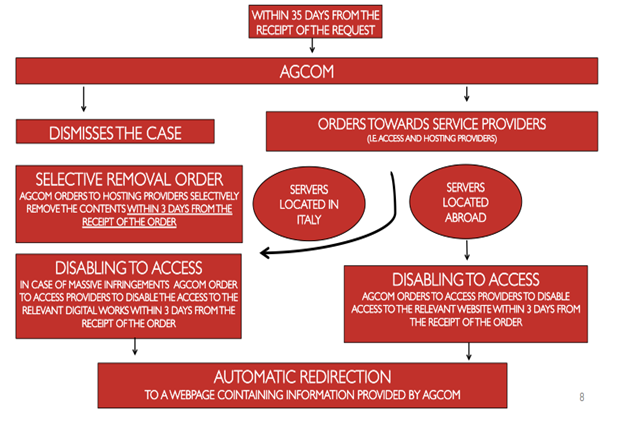
In this perspective, this blog's readers Portolano e Cavallo Studio Legale’s Regulation Toolkit may come as a helpful resource to navigate safely the sea of the AGCOM Regulation. The Toolkit is composed of two documents. The first one is a non-official English translation of the final version of the Regulation. Notably, its English appears to be much more stylish (and not less reliable) than the one used in the official English translation of the first draft, penned by the AGCOM itself and available here.

The second document is a graphic handbook where the pillars of the Regultion are delved with thanks to user-friendly red-coloured charts. To give 1709 Blog readers a preview, here are some pillars' pills on the procedure (regular track)…


… and on the “tragedy” that an ISP may face in case of non-compliance with AGCOM’s order:


Beyond the procedural diagrams, the Portolano's Toolkit is also worthwhile to learn some vocabulary. Thanks to its help, the foreign reader (and the Italian one alike) may become aware of brand-new categories that might populate the Italian copyright enforcement world from March onwards.

One of the most intriguing is "digital work", i.e. the particular subject-matter that the Regulation aims to protect. Pursuant to Article 1, (p), this is "a work, or parts thereof, with audio, audiovisual, photographic, videoludic, editorial and literary nature, including the applicative programs and the computer operating systems protected by Copyright Law and diffused on electronic communication networks". It is somehow innovative and super-broad definition that well-highlights the wide scope of application of the Regulation and of AGCOM’s potential influence in the Italian IP scenario in the next future. Another “alarming” one is "Webpage Manager" that, pursuant to Article 1, (h) is "who, within a website, manages a page where are present digital works or part thereof or hyperlinks […] to the same". Are 1709 Blog authors Webpage Managers? No one still knows, but in any event please
Average highly-trained team (of trainees)
specialised in handling AGCOM requests 
consider carefully that the red diagrams above are (likely to be) copyright-protected and that our Portolano friends own the relevant rights.

Interestingly, in the last slide of the Handbook the Portolano guys suggest that the potential targets of AGCOM orders (i.e., hosting and access providers) may have to “setup internal processes to manage AGCOM requests”. This might be handled by an “internal team trained and specialised in AGCOM requests and proceedings management”. Considering the fines that an ISP may be ordered to pay in case of non-compliance (from EUR 10,000 to over EUR 250,000), this might be a good idea. But is this at hand for newly established start-ups and ISPs with shoulders less broad than those of big multinational tech companies?"

Wednesday, 10 April 2013

Italian Communication Authority announces draft online copyright regulation by end of summer


Italian copyright fans will remember that previous commissioners of AGCOM (Autorità per le Garanzie nelle Comunicazioni - Italian Communication Authority) struggled with the adoption of an administrative regulation to protect copyright over the internet for quite a long time, but no such regulation was adopted before the end of their office last year (here, here, here).

One of the main problems encountered by AGCOM was its apparent lack of competence to legislate in the area of copyright. Former AGCOM president and erotic poet Corrado Calabrò indeed asked the Government (and Parliament) to clarify this point and, more in general, the nature and extension of AGCOM powers in the area of copyright.

Nothing of this sort has happened yet.

New AGCOM president Angelo Cardani
New AGCOM members were elected last June, following a reform of the structure of the Authority itself which resulted - among other things - in the number of commissioners being reduced from 8 to 4. Despite budgetary cuts, the idea of an online copyright regulation appears still vivid in both the minds and hearts of new AGCOM members.

Last December, new commissioner Maurizio Decina spoke about various copyright issues. Besides his opinion that ISPs should not be required to pay royalties for displaying links to and snippets of contents, Decina declared that, while Italian Government should clarify the nature and extension of AGCOM competencies in the field of copyright, he announced that - even this should not happen - the Authority would go ahead and adopt a specific regulation anyway.

Average (and slightly stressed)
Italian copyright lawyer
can't wait to see the draft regulation
After the end of an endless and cold winter (at least for Italian standards), yesterday AGCOM president Angelo Cardani announced that by this summer the Authority will issue a draft regulation on online copyright protection, which will then be subject to public consultation. This will happen even without a legislative intepretation of the actual competencies of the Autority in the area of copyright. As explained by Cardani, 

"when dealing with technical aspects and fundamental rights, perhaps it would be better for the Parliament to be in charge, but previous Parliament did not want to address these issues (or rather, it was busy otherwise), and we do not know what current Parliament intends to do. Therefore technicians [these being AGCOM members] will do their job. We will safeguard pluralism and right of access, and we will not have any doubts or hesitations [to go ahead and adopt an online copyright regulation]".

Will this really happen? Still according to Cardani, so far the new Authority has always kept its promises, and this will be the case also for the online copyright regulation.

We have then to wait a few more months to see the draft regulation unveiled. In the meanwhile, it is worth recalling that debate about copyright enforcement is currently taking place a bit everywhere. US Register of Copyrights Maria Pallante recently announced the need for the US to update its copyright system, including enforcement provisions (here and here). Likewise, following an orientation debate, at the end of last year EU Commission agreed a way forward for modernising copyright in the digital economy and, among other things, announced the need to discuss how to improve the legitimacy of enforcement in the context of wider copyright reform.

Wednesday, 2 May 2012

Game over: no online copyright regulation in Italy

As readers of this Blog will remember, the Italian Communication Authority (AGCOM) has tried for a couple of years to adopt an administrative regulation to protect copyright over the internet. 
Since last March, AGCOM has sent out contradictory signals as to whether it would have actually gone ahead and adopted the regulation before its current members (who have held their office for seven years) are replaced in a few days' time (see earlier posts here and here).
Lately, one of the main criticisms raised against AGCOM's draft regulation has focused on its actual lack of competence to legislate in the area of copyright. At the end of March there have been rumours that Mario Monti's government would adopt a proviso (to be probably included in a law decree) aimed at clarifying (or, according to some commentators, allowing) AGCOM's competence to this end (see earlier 1709 Blog’s post here).
This morning, AGCOM President Corrado Calabrò delivered what is likely to be his last speech in this capacity before the Italian Senate.
Here, Calabrò summarised AGCOM's action and role over the past seven years and, among the other things, highlighted that, while in 2005 the largest corporation by market capitalisation was Esso, now this position has been taken over by Apple, which has bigger market capitalisation than Milan Stock Exchange.
Calabrò observed that some of AGCOM's competences touch upon fundamental rights, such as freedom to conduct a business, social dignity, rights of children, pluralism, and freedom of expression and information.
It is up to primary legislation, said Calabrò, to set up a general framework in these areas. However, fine tuning (as Calabrò called it) and technical provisions are better provided by an administrative regulatory body such as AGCOM.
As far as copyright is concerned, AGCOM has had the great merit of starting a discussion as to the protection of copyright over the internet, in a country which has a seventy-year old copyright statute [is this to be considered as an achievement? If so, then Italy is a few years - to say the least - behind the rest of Europe].
Although AGCOM has showed its ability to reconcile the various rights and interests involved in copyright, it will not go ahead with its copyright regulation. This is because Italian Government has not yet adopted the proviso needed to clarify the nature and extension of AGCOM's competence to this end. Therefore, until this happens, AGCOM will not feel obliged to adopt its "well-balanced" regulation.


So this is the final result of two years of debate. If this was a film, it would probably be a Commedia all'italiana. According to the Wikipedia entry,
"rather than a specific genre, the term indicates a period in which the Italian film industry was producing mainly brilliant commedies, with some common traits like satire of manners and a prevailing middle-class setting, often characterized by a substantial background of sadness that would dilute the comic contents."

Friday, 30 March 2012

More news on the online copyright regulation in Italy

Falkor was such a cutie, but
this is not what the post is about
Readers of this Blog who were kids in the 1980s, have a passion for fantasy films or are fans of Michael Ende's books will certainly remember The Never Ending Story. More than the plot of this book/film or mesmerising characters such as Falkor the luck dragon, it is its title (also recalled by La Repubblica) which is appropriate to describe the new developments in the Italian online copyright regulation saga (earlier posts here and here). 
Yesterday Italian newspaper La Stampa published what it claimed to be a draft memo/decree (this is not clear yet) prepared by Monti's government to make it clear (according to some commentators, it would be better to say 'allow') that the Italian Communication Authority (AGCOM) may go ahead with its draft online copyright regulation and publish it before its members are replaced next May.
In theory, such a memo/decree, which carries the title Disposizioni interpretative in materia di competenze dell'Autorità per le garanzie nelle comunicazioni' ("Interpretative provisions as to the competences of AGCOM") would be aimed at merely clarifying that the Italian Communication Authority has the competence to adopt its proposed regulation.

As it is unknown who drafted this memo/decree and gave it to La Stampa, this information lacks any official character and the contents may well be changed. However, the draft memo/decree includes a set of provisions which are fairly interesting to read, in that they set out guidelines as to the contents of the regulation.
In brief, these are the main points in the alleged Government's draft memo/decree:
(1) AGCOM is to be meant as the competent 'administrative authority' pursuant to Articles 14 to 17 of Legislative Decree No 70, 9 April 2003, by which Italy transposed into national law Articles 12 to 15 of the E-Commerce Directive [this, according to some commentators, would reduce the competences of two other administrative authorities, these being the Competition and Data Protection Authorities];
(2) AGCOM shall be competent to settle any controversies concerning the application of the Italian Copyright Act (Law No 633, 22 April 1941) over the internet [this point does need clarification, as it would be very difficult to sustain the legitimacy of a proviso which forbids the parties to a controversy from commencing court proceedings at any stage during this procedure];
(3) Within 30 days from the entry into force of the Government's (memo/)decree, AGCOM shall adopt a regulation which includes notice and takedown procedures relating to any contents made available in Italy by providers located anywhere in the world, and which are contrary to the Italian Copyright Act [this raises a few private international law issues, also because the law is far from settled in relation to infringements carried out over the internet];
(4) In case of non-compliance with AGCOM's orders (including cease-and-desist), fines pursuant to Article 1(30-31) of Law No 249, 31 July 1997, shall be issued [fines due to non-compliance with AGCOM's requests for documents, data and information, range between EUR 516,46 and EUR 103.291,38; fines due to non-compliance with AGCOM's orders (including cease-and-desist) range between EUR 10.329,14 and EUR 258.228,45]
(5) In case of serious infringements or reiteration of illicit activities, in addition to the fines just mentioned, AGCOM shall terminate access to the service [perhaps to be intended as internet access tout court, in pure Hadopi-style?] or, only if possible [does this mean that impeding 'access to the service' comes first?], to the contents made available and which infringe the Italian Copyright Act;
(6) AGCOM shall promote initiatives aimed at encouraging the adoption of codes of conduct to regulate the relationship between copyright owners and service providers, in order to encourage the legal supply of contents over electronic communication networks;
(7) Article 1(5-6) of Law No 128, 21 May 2004 shall be no longer in force [Article 1(5) provides for service providers, following a court order, to communicate to the police any information which may serve to locate websites and those responsible for such illicit activities; Article 1(6) provides for service providers, following a court order, to either impede access to infringing contents or remove such contents].
It is certainly an excellent thing that the future of copyright is discussed widely in Italy, also among the general public. However, as often happens, over-simplifications and/or exaggerations should be avoided, in that the issues on the table are heterogeneous and call for special attention. 
The Never Ending Story was about the charming world of Fantasia, which was threatened by a force called The Nothing, a void of darkness which consumed everything. By reading some comments in the general press, one may get the impression that also Italy is threatened by The Nothing, also known as copyright enforcement over the internet.

Wednesday, 28 March 2012

Online copyright regulation to be adopted in Italy (definitely maybe)

Corrado Calabrò 
A few days ago this Blog reported on the uncertain fate of the online copyright regulation the Italian Communication Authority (AGCOM) has been trying to adopt over the last year and a half.
Last week's hearing of AGCOM President Corrado Calabrò before two commissions of the Italian Senate has left many copyright owners pretty disappointed, in that it seemed that the AGCOM would not adopt any regulation in the immediate future.
Now the scenario appears to have changed. AGCOM may be keen to issue its online copyright regulation before its members are replaced next May. 
In a letter sent to Italian newspaper Corriere della Sera last Saturday, as well as during another hearing at the Senate this morning, Calabrò made it clear that AGCOM has not given up the idea of going ahead with its regulation. 
Antonio Catricalà
However, the Communication Authority is said to be waiting for Mario Monti's Government to say whether AGCOM is actually competent to adopt a general copyright regulation. A member of the Government and former President of the Italian Competition Authority Antonio Catricalà is apparently working on this. What is needed is an interpretation of AGCOM's powers to this end, as resulting from: 
(1) Article 6 of Legislative Decree No 44, 15 March 2010 (by which Italy implemented Directive 2007/65/EC -- the so called Audiovisual Media Services Directive); 
(2) Article 182-bis of the Italian Copyright Act (Law No 633, 22 April 1941); and 
(3) Legislative Decree No 70, 9 April 2003 (by which Italy implemented Directive 2000/31/EC -- the so called Ecommerce Directive).
So now the idea would be to adopt the regulation after Easter break, as reported by Milano Finanza
A copyright regulation to be adopted, Definitely Maybe? This blogger suggests that, rather than the title of the first album by Oasis, it would be better to revert to something more recent in time:
'Cause you're hot then you're cold
You're yes then you're no
You're in then you're out
You're up then you're down 

... To be continued ...

Thursday, 22 March 2012

No online copyright regulation to be adopted in Italy (for now)

Readers of this Blog who have both a passion for Italian affairs (no, those of former Prime Minister Silvio Berlusconi are not among them), and good command of Dante's language will have followed the eighteen-month saga concerning the proposal of the Italian Communication Authority (Autorità per le Garanzie nelle Comunicazioni - AGCOM) to adopt an administrative regulation to protect copyright over the internet.

Following its own assessment of issues relating to copyright protection over electronic communication networks, in December 2010 AGCOM published its draft regulation on copyright over electronic communication networks and launched a public consultation aimed at receiving comments from concerned parties.

The main criticism against AGCOM's proposal concerned the actual lack of competence of an administrative authority such as AGCOM to legislate in the area of copyright. Although Article 182-bis of the Italian Copyright Act (Legge No 633, 22 April 1941) provides that AGCOM and Italian collecting society SIAE (Società Italiana degli Autori ed Editori) are entitled to prevent and stop copyright infringements, it has been argued that AGCOM could have not possibly adopted a general copyright regulation. 
AGCOM President Corrado Calabrò
Article 6 of Legislative Decree No 44, 15 March 2010, by which Italy implemented Directive 2007/65 (the so called Audiovisual Media Services Directive) provides AGCOM with a regulatory competence in the field of copyright, but this is limited to audiovisual media services. 
The main purpose of the regulation would be to institute a simple, quick and proportionate procedure for granting protection against copyright violations. 
To this end, AGCOM proposed a complaint procedure composed of the following phases. 
First, complaints of alleged violations would be brought by copyright owners to  service providers, identifying infringing activities or information and requesting their removal. If the service provider did not proceed to remove such contents within 48 hours of the request, AGCOM would verify, by questioning only the content owner and the service provider, whether the contents were actually illicit and, if so, order the removal of the files from the server or the links to external websites.
This procedure, according to AGCOM, would have been akin (?) to the notice and takedown system envisaged by §512 of the US Digital Millennium Copyright Act (DMCA). Anyway, following a series of protests, the proposed regulation was amended and in July 2011 a new draft regulation was published. 
In contrast with the previous version, the new draft regulation provided for the procedure before AGCOM to be alternative to court proceedings. In particular, no procedure before AGCOM could have commenced (a) before the end of the actual "notice and takedown" procedure between the ISP and the right holder; and (b) if the right holder had decided to commence court proceedings.
The logo of one of the protests
organised against the
draft AGCOM regulation 

last summer
This new draft Regulation has been subject to criticisms, in relation to fundamental rights of the users, freedom of the ISPs to conduct their businesses, jurisdiction over Italian-directed foreign websites, etc. 
Yesterday, during a hearing before two commissions of the Italian Senate, AGCOM President Corrado Calabrò announced that it is unlikely that AGCOM will adopt any regulation on copyright over electronic communication networks in the immediate future. 
Calabrò made it clear that AGCOM would be competent to adopt such regulation - inter alia - in light of the provisions contained in Directive 2000/31 (the Ecommerce Directive), as implemented in Italy by Legislative Decree No 70, 9 April 2003. In addition, the proposed Regulation would be in line, said Calabrò, with recent CJEU case law (see 1709 Blog posts here and here), in that it would impose on ISPs neither a general obligation to monitor, nor the installation of filtering systems. 
This said, however, AGCOM President deemed it necessary for the Italian Parliament first to revise Italian copyright law (the current statute dates back to 1941). Moreover, he added "since copyright is borderless, the most appropriate venue for new copyright laws - at least as far as general guidelines are concerned - would be the EU, if not the UN" [did Calabrò mean WIPO, this blogger wonders].
"We are fed up with people who keep asking
whether we are boys or girls! Let's talk
about online copyright instead ..."
So it seems that nothing will happen, as current members of AGCOM will be replaced shortly. 
Right holders were pretty upset because of what happened yesterday at the Senate. In the words of Enzo Mazza, chairman of FIMI (Federazione Industria Musicale Italiana), "More than two years have been dedicated to hearings, draft regulations and debates over the gender of angels and now they say they lack competence to this end? It's ridicolous!"
Perhaps all this story is just good to revert to Samuel Beckett and say that here too "The sun shone, having no alternative, on the nothing new".