Showing posts with label online copyright enforcement regulation. Show all posts

Friday, 17 January 2014

May AGCOM Regulation become redundant?

Dr Giuseppe Mazziotti
(pictured in Florence)
A few weeks ago the Italian Communication Authority (AGCOM) issued its Regulation on online copyright enforcement [on which see herehere and here; unofficial English translation is available here]

The Regulation has not yet entered into force, but has attracted considerable attention already. 

Today The 1709 Blog is delighted to host a thorough and sharp analysis by Dr Giuseppe MazziottiAssociate Fellow at the Centre for European Policy Studies (CEPS), Brussels and founder of Mediartis, Rome.

Here's what Giuseppe writes:

"Understanding why AGCOM recently adopted an administrative regulation on online copyright enforcement – in spite of the issues and perplexities raised by the European Commission in its letter on 3 December 2013 [see here] -  would be hard (or even impossible) without briefly considering the background to this initiative and today’s Italian political scenario. 

As the readers of this blog know, the regulation creates a new notice-and-takedown (NTD) procedure that will be handled by AGCOM itself and will have ISPs as the main targets of website blockings, measures aims at disabling access to entire websites in case of massive copyright infringements and, in case of non-compliance, heavy administrative fines. As a result of the entry into force of the regulation (on 31 March 2014) copyright holders will be placed in a position to ask AGCOM to order mere conduit and hosting providers to restrict access to infringing materials by Internet users. 

The AGCOM regulation does not contemplate any provisions with regard to infringements carried out by individuals on peer-to-peer networks; nor does it embody measures aimed at restricting the activities of caching or linking providers.

The main purpose of the new regulation is that of making copyright enforcement fast (or, as it was said, “super-fast”) and more effective in a country where a smooth functioning of the notice-and-takedown procedures foreseen under the e-Commerce Directive has been hindered by its erroneous (and unsuitable) transposition into Italian law. 

According to the Italian legislative decree that implemented the e-Commerce Directive, requests of takedown of illegal content should be notified to ISPs by means of “communications” by competent judicial or administrative authorities in order to acquire a legally binding force. In other words, in Italy the obligation for ISPs to act “…. expeditiously to remove or to disable access to the information…” does not arise at the time when an ISP obtains knowledge or becomes aware of illegal activities or infringing content occurring on its servers (cf Article 14 of the e-Commerce directive). Rather, such obligation arises (only) when a notice is communicated to an online intermediary by a judicial or administrative authority. 

This does not mean that the largest providers of hosting services operating in Italy have followed such approach: Google, Facebook, Twitter and many others have spontaneously adopted informal notice-and-takedown procedures. 

Still, the way Italy transposed the liability exemption rules embodied in the e-Commerce Directive reflects the idea that public authorities should be involved in the context of online enforcement procedures from the outset. This is the same idea that the new regulation is based upon, considering that

(i)      the administrative procedure has to start by a review of the admissibility of the infringement claim and a notification made by AGCOM to "the suitably-identified service provider", to the "uploader" and to the webpage and website manager and
(ii)     the copyright holder's request is transmitted to AGCOM’s judging panel – acting as a possible substitute (or duplicate) of a proper judicial authority - after the formal notification procedure.

So, what is new in the regulation? What might make its enforcement suitable?

Time constraints: the only thing?
The answer is: The creation of time constraints for the whole procedure (and even more so for the faster procedure envisaged by the regulation) and the sanctioning power that AGCOM granted to itself (!) with regard to fines are certainly elements of novelty, whose effectiveness will have to be tested as soon as the regulation becomes applicable. 

One might legitimately wonder whether a relatively small authority like AGCOM will have the human and technical resources to handle large amounts of claims and proceedings and putting them to an end in a timely manner. 

The reason why the enforcement of the regulation might be useful from a policy-making perspective is that the gravity of website blockings and online restrictions that AGCOM might end up ordering to ISPs could trigger a suitable political debate and persuade the Italian Parliament – ie the next one, not the current one, where there is no clear political majority – to eventually enact a reform of civil enforcement proceedings, in line with both the e-Commerce Directive and the Intellectual Property Rights Enforcement Directive, known as ‘IPRED’.  

If Italy will make enforcement of digital copyright smoother through the implementation of balanced notice-and-takedown procedures and access to IP-specialised courts easy and effective for all categories of copyright holders - including individual right-holders and small and medium-size content producers - there will be no reason to keep a substitute such as AGCOM regulation in force for long." 

Wednesday, 15 January 2014

BREAKING NEWS: EU Commission had serious doubts about Italian Communication Authority draft online copyright enforcement regulation

As just announced on the IPKat, today fellow Kat Alberto Bellan and I finally got access to the super-mysterious letter [available here] that the EU Commission sent to the Italian Communication Authority (AGCOM), shortly prior the adoption of its Regulation on online copyright enforcement [on which see here and here; unofficial English translation is available here]

As recalled here, by adopting its Regulation AGCOM set a very important precedent, for Italy and the EU alike. As regards the former, it is the first time in Italy that an administrative authority (as is AGCOM) has vested itself with powers (to grant injunctions) which traditionally have fallen within the competence of courts. As regards the latter, the Italian experiment has the potential to be looked at with either interest or fear by the other Member States, as well as informing debate around forthcoming review of the InfoSoc and Enforcement Directives.

Also in consideration of the "innovative" approach to be taken in the Regulation, the EU Commission was asked to provide comments on its first draft [see notification webpage here] focusing on compatibility with EU law, notably the Ecommerce Directive and the Charter of Fundamental Rights of the European Union.

Contrary to what AGCOM President Marcello Cardani declared a few hours ago during a hearing before the Italian Parliament, the EU Commission had many questions and serious doubts about the draft regulation that AGCOM was thinking of adopting. Amongst others, doubts related to compatibility with the fundamental right of defence.

Read it all on the IPKat and let us know what you think!

Tuesday, 17 December 2013

Still on the Italian Communication Authority’s Regulation

A few days have passed since the Italian Communication Authority (AGCOM) issued its Regulation on Online Copyright Enforcement [breaking news by The 1709 Blog here and extremely helpful and detailed comment on the IPKat here]

Today, The 1709 Blog is delighted to publish a further analysis by its highly-reputed world expert on AGCOM matters, who so writes in incognito [is he/she a member of AGCOM? A Google employee? A lawyer from a law firm? Nobody really knows …]:

“Following the enactment of AGCOM Regulation, commentators are still debating what this new mechanism may entail for IP protection and freedom of the Internet. Meanwhile, there appears to be one thing that the Regulation will bring for sure, suggest some [naughty] practitioners: more business for the legal sector. So considered, law firms in Italy are getting ready for dealing with a possibly hugely increased amount of (administrative) litigation to which the Regulation may give rise from 31 March 2014 (this being the date when this is due to enter into force).

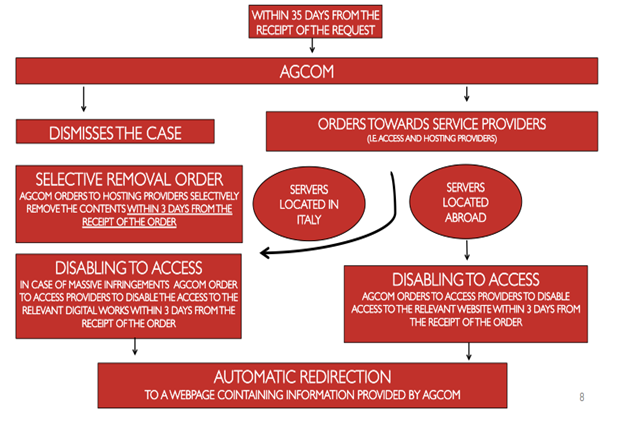
In this perspective, this blog's readers Portolano e Cavallo Studio Legale’s Regulation Toolkit may come as a helpful resource to navigate safely the sea of the AGCOM Regulation. The Toolkit is composed of two documents. The first one is a non-official English translation of the final version of the Regulation. Notably, its English appears to be much more stylish (and not less reliable) than the one used in the official English translation of the first draft, penned by the AGCOM itself and available here.

The second document is a graphic handbook where the pillars of the Regultion are delved with thanks to user-friendly red-coloured charts. To give 1709 Blog readers a preview, here are some pillars' pills on the procedure (regular track)…


… and on the “tragedy” that an ISP may face in case of non-compliance with AGCOM’s order:


Beyond the procedural diagrams, the Portolano's Toolkit is also worthwhile to learn some vocabulary. Thanks to its help, the foreign reader (and the Italian one alike) may become aware of brand-new categories that might populate the Italian copyright enforcement world from March onwards.

One of the most intriguing is "digital work", i.e. the particular subject-matter that the Regulation aims to protect. Pursuant to Article 1, (p), this is "a work, or parts thereof, with audio, audiovisual, photographic, videoludic, editorial and literary nature, including the applicative programs and the computer operating systems protected by Copyright Law and diffused on electronic communication networks". It is somehow innovative and super-broad definition that well-highlights the wide scope of application of the Regulation and of AGCOM’s potential influence in the Italian IP scenario in the next future. Another “alarming” one is "Webpage Manager" that, pursuant to Article 1, (h) is "who, within a website, manages a page where are present digital works or part thereof or hyperlinks […] to the same". Are 1709 Blog authors Webpage Managers? No one still knows, but in any event please
Average highly-trained team (of trainees)
specialised in handling AGCOM requests 
consider carefully that the red diagrams above are (likely to be) copyright-protected and that our Portolano friends own the relevant rights.

Interestingly, in the last slide of the Handbook the Portolano guys suggest that the potential targets of AGCOM orders (i.e., hosting and access providers) may have to “setup internal processes to manage AGCOM requests”. This might be handled by an “internal team trained and specialised in AGCOM requests and proceedings management”. Considering the fines that an ISP may be ordered to pay in case of non-compliance (from EUR 10,000 to over EUR 250,000), this might be a good idea. But is this at hand for newly established start-ups and ISPs with shoulders less broad than those of big multinational tech companies?"

Thursday, 12 December 2013

Italian Communication Authority issues online copyright enforcement regulation (at last)

Following an earlier failed attempt, a (good) number of mixed signals, suggestions of missing competence to adopt a regulation, a public consultation [handily launched in August last], allegations of violating fundamental freedoms, and EU Commission's evaluation (here, here, hereherehere), this morning the Italian Communication Authority (AGCOM) published its Regulation on online copyright enforcement, or Regolamento in materia di tutela del diritto d'autore sulle reti di comunicazione elettronica e procedure attuative as sensi del Decreto Legislativo 9 Aprile 2003, No 70 [by adopting Legislative Decree 9 April 2003, No 70, Italy implemented the Ecommerce Directive]

The Regulation, which will enter into force on 31 March 2014, follows AGCOM's own consideration that something must be done at the level of public institutions to contrast digital piracy. The Regulation is aimed at "massive violations", not individual users and P2P activities. As such, the Regulation "does not affect online freedoms at all".

No, he's not a new member of AGCOM ...
But still ...


Similarly to what was recently recommended in France by the Lescure Report (here and here), the Regulation emphasises how more effective enforcement must go hand in hand with the promotion of legal content offers, education and information of consumers [notably younger ones], and adoption of codes of conduct. 

Overall, the Regulation contains a detailed discipline of an innovative [also in the sense that AGCOM not only drafted and adopted the Regulation, but will be also competent to apply it ... Is that L'Etat c'est moi 2.0 or what?] "notice and takedown" procedure that is intended - among other things - to be particularly swift and effective. 

A more detailed analysis of the Regulation will follow shortly on the IPKat.