


Model Airtable Data Using Azure Analysis Services

Microsoft Azure Analysis Services (AAS) is a fully-managed platform-as-a-service (PaaS) offering that delivers enterprise-grade data models in the cloud. When combined with CData Connect AI, AAS facilitates immediate cloud-to-cloud access to Airtable data for applications. This article outlines the process of connecting to Airtable via Connect AI and importing Airtable data into Visual Studio using an AAS extension.
CData Connect AI offers a seamless cloud-to-cloud interface tailored for Airtable, enabling you to create live models of Airtable data in Azure Analysis Services without the need to replicate data to a natively supported database. While constructing high-quality semantic data models for business reports and client applications, Azure Analysis Services formulates SQL queries to retrieve data. CData Connect AI is equipped with optimized data processing capabilities right from the start, directing all supported SQL operations, including filters and JOINs, directly to Airtable. This leverages server-side processing for swift retrieval of the requested Airtable data.
Prerequisites
Before you connect, you must first do the following:
- Connect a data source to your CData Connect AI account. Detailed steps are provided in the next section.
- Generate a Personal Access Token (PAT). Copy this down, as it acts as your password during authentication.
- Create a server in Azure Analysis Services to which you will deploy your data from CData Connect AI.
- Install and configure an On-Premise Gateway in your system. This will pull data from the source via CData Connect AI into the Azure Analysis Services project and deploy models to the server. Refer to the given link to find the detailed process.
Configure Airtable Connectivity for AAS
Connectivity to Airtable from Azure Analysis Services is made possible through CData Connect AI. To work with Airtable data from Azure Analysis Services, we start by creating and configuring a Airtable connection.
- Log into Connect AI, click Sources, and then click Add Connection
- Select "Airtable" from the Add Connection panel
-
Enter the necessary authentication properties to connect to Airtable.
APIKey, BaseId and TableNames parameters are required to connect to Airtable. ViewNames is an optional parameter where views of the tables may be specified.
- APIKey : API Key of your account. To obtain this value, after logging in go to Account. In API section click Generate API key.
- BaseId : Id of your base. To obtain this value, it is in the same section as the APIKey. Click on Airtable API, or navigate to https://airtable.com/api and select a base. In the introduction section you can find "The ID of this base is appxxN2ftedc0nEG7."
- TableNames : A comma separated list of table names for the selected base. These are the same names of tables as found in the UI.
- ViewNames : A comma separated list of views in the format of (table.view) names. These are the same names of the views as found in the UI.

- Click Save & Test
-
Navigate to the Permissions tab in the Add Airtable Connection page and update the User-based permissions.
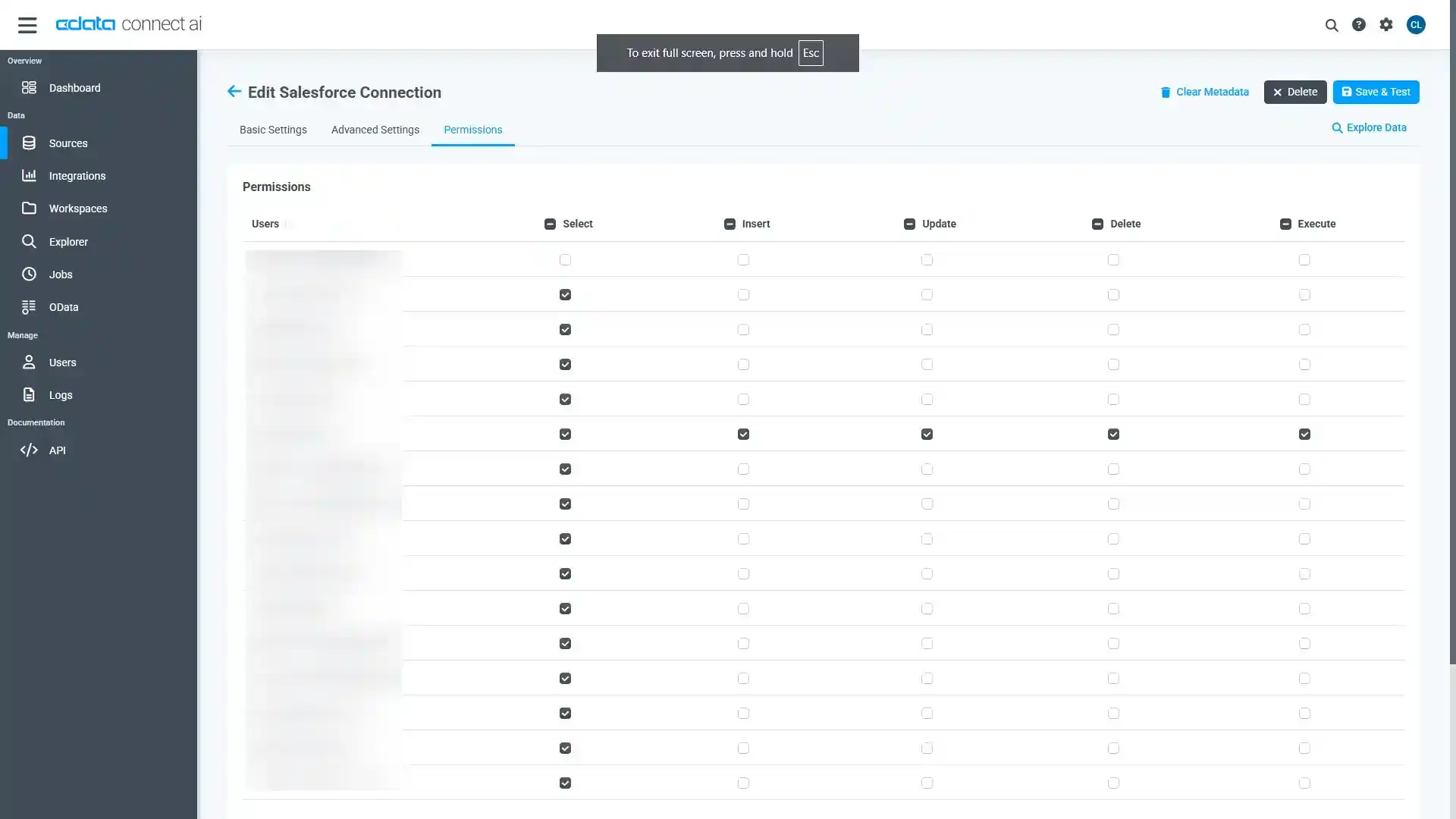


Add a Personal Access Token
When connecting to Connect AI through the REST API, the OData API, or the Virtual SQL Server, a Personal Access Token (PAT) is used to authenticate the connection to Connect AI. It is best practice to create a separate PAT for each service to maintain granularity of access.
- Click on the Gear icon () at the top right of the Connect AI app to open the settings page.
- On the Settings page, go to the Access Tokens section and click Create PAT.
-
Give the PAT a name and click Create.

- The personal access token is only visible at creation, so be sure to copy it and store it securely for future use.
With the connection configured and a PAT generated, you are ready to connect to Airtable data from Visual Studio using Azure Analysis Services.
Connect to Airtable in Visual Studio Using AAS
The steps below outline connecting to CData Connect AI from Azure Analysis Services to create a new Airtable data source. You will need the Microsoft Analysis Services Project extension installed in Microsoft Visual Studio to continue.
- In Visual Studio, create a new project. Select Analysis Services Tabular Project. Click on Next.
- In the Configure your new project dialog box, enter a name for your project in the Project name field. Fill in the rest of the fields.
- Click on Create. The Tabular model designer dialog box opens. Select Workspace server and enter the address of your Azure Analysis Services server (for example, asazure://eastus.azure.windows.net/myAzureServer). Also, make sure to select the option SQL Server 2022 / Azure Analysis Services (1600) from the Compatibility level dropdown. Click on Test Connection to check if the connection details are correct. Click OK and sign in to your server.
- Now, click on OK to create the project. Your Visual Studio window should resemble the following screenshot:
- In the Tabular Model Explorer window of Visual Studio, right-click Data Sources and select Import From Data Source.
- In the Get Data window, select SQL Server database and click Connect. In the Server field, enter the Virtual SQL Server endpoint and the port separated by a comma: e.g., “tds.cdata.com, 14333”, and click on OK.
- Click on Database and enter the following information:
- User name: Enter your CData Connect AI username. This is displayed in the top-right corner of the CData Connect AI interface. For example, [email protected].
- Password: Enter the PAT you generated on the Settings page.
Click on Connect. If successful, the Navigator window will pop up.

-
In the Navigator window, search and select the tables of your choice

- You should now see the Salesforce table populated with data in the preview section on the right panel.
-
Click on Load to import the data.


Now that you have imported the Airtable data into your data model, you are ready to deploy the project to Azure Analysis Services for use in business reports, client applications, and more.
Get CData Connect AI
To get live data access to 300+ SaaS, Big Data, and NoSQL sources directly from your cloud applications, try CData Connect AI today!
